
If you've played D&D, you've probably heard that Daggerheart combat has no initiative, and you've probably had the same reaction everyone has: so who goes next, whoever yells loudest? Fair question. This guide takes it seriously, gives D&D its due, answers the objections one at a time, and ends with a flowchart you can print. I made this flowchart for my own table.
Why initiative feels right
Initiative is a good system, and it's worth saying what you'd be giving up. The 5.2 SRD sets combat up in steps: establish positions, roll Initiative, then take turns in order until one side is done.
That predictability is real. You can plan a round, and nobody has to wonder whether they're being overlooked. If that's what you love about D&D, keep it.
Objection: the loud player hogs it
Without an order, wouldn't the most talkative player take every turn? The rules have an answer. Daggerheart tracks the spotlight, the table's focus. It doesn't sit with one person. Between rolls it moves to whoever the story points at next, or to a character who hasn't had the focus in a while, and a player can't spend it all, because a roll often hands it away.
If your table wants a harder guarantee, the SRD offers an optional tracker: each player gets a few tokens, spends one per action, and the spotlight skips anyone who's out until everyone has used theirs. That's close to a turn budget, for the groups that miss one.
Objection: it's not balanced, players can just keep making moves
Without a turn limit, what stops one character from acting forever? The dice. In a fight, almost nothing is free. Moving within Close range rides along with an action roll, so it's a roll too. Moving farther, or with no other action to ride on, takes an Agility Roll. Intimidating a foe is a Presence roll. Drinking a potion needs no roll until the GM decides a blade at your throat calls for one. Every roll risks a failure or a roll with Fear, and either one swings the spotlight to the GM. Even a hot streak with Hope can't run forever: the GM can spend Fear to cut in.
Objection: there's no pacing
This is where the dice take over. An action roll uses two d12s, Hope and Fear, and which one is higher matters as much as the total. Roll with Hope and the spotlight stays with the players. Roll with Fear and the GM gains 1 Fear and takes the spotlight, whether you succeeded or not. A failure with Hope also swings it to the GM, with a minor consequence.
So the rhythm comes from the roll, not from a list. A good run of Hope rolls feels like momentum, and a Fear roll is the story turning on you. How often that happens at each Difficulty is in the Daggerheart dice odds guide, and the chart on its own page shows every one.
Objection: the monsters never act
They do. The GM makes a move when a player rolls with Fear, fails a roll, does something with consequences, or looks to the GM for what happens next. A move can spotlight an adversary, who then moves and attacks, uses an action, or does whatever the fiction calls for. Then the spotlight goes back to the players.
The GM can also interrupt. Fear collects from the players' rolls and from rests, and the GM can spend 1 of it to steal the spotlight and make a move, or to make an extra one. That's the part with no D&D equivalent in a standard fight: the players' rolls build up a pool the GM can spend to cut in. Every roll, hit or miss, also changes the scene. The SRD calls this failing forward.
Objection: it's chaos
It looks that way until you see the loop. Here's the whole thing in one picture.
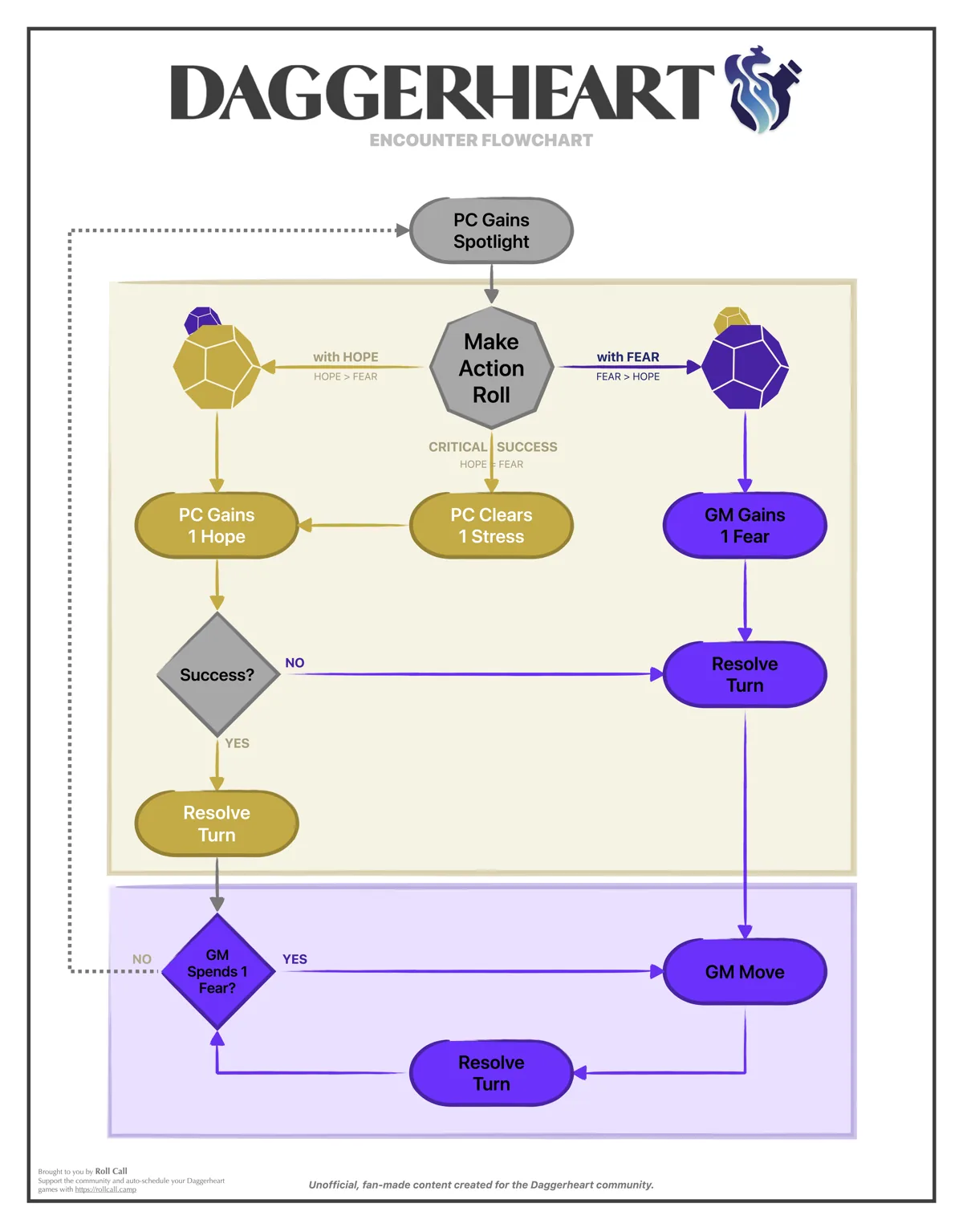
- A player has the spotlight. They say what their character does. If success would be trivial or failure boring, it just happens. If it's risky, the GM calls for an action roll.
- Make the action roll. Roll the Hope and Fear dice, add your modifiers, and compare the total to the Difficulty. Then look at which die is higher.
- Rolled with Hope. You gain 1 Hope. On a success the spotlight stays with the players. On a failure it swings to the GM.
- Critical success. The dice match. It counts as a roll with Hope and an automatic success: you gain 1 Hope and clear 1 Stress.
- Rolled with Fear. The GM gains 1 Fear and takes the spotlight. A success comes with a cost or complication, and a failure brings a major consequence.
- The GM move. The GM makes a move, which can mean spotlighting an adversary.
- Spending Fear. On the flowchart's last diamond, the GM can spend 1 Fear to cut in and make another move, even after a player succeeds with Hope, and can continue to spend more Fear for extra moves. If not, the spotlight returns to the player characters.
That's all of it. Nothing in the loop is open-ended: every roll ends in one of those branches, and every branch says who has the spotlight next.
What you gain
Here's what the looser order buys you at the table. Nobody sits through five other turns to say one line. A player can react to what just happened while it's still fresh. When a roll goes wrong, the scene turns right then, instead of waiting for a monster's slot in the order. Fights tend to read like scenes in a story, with a beginning, a swing and a recovery, rather than a sequence of separate turns.
It does ask something in return. There's no guaranteed turn, so the GM has to notice who hasn't had the focus, or use the token tracker. The GM also has more live at once: Fear, the spotlight and the adversaries. That's a trade worth making. Initiative makes sure everyone gets a turn. The spotlight lets every turn follow the fiction, and keeps everyone leaning in, because the next turn could be anyone's.
Try one fight this way
You don't have to switch games to find out. Run a single fight by the loop above, and see if you want to go back. The flowchart is a one-page PDF you can keep behind a GM screen or share with your players.
It's free to print and share at your table.
While you're here, check out Roll Call, the auto-scheduler for your Daggerheart games. (Discord bot available!)
Fights leave statuses to track, too. The Daggerheart conditions guide covers Hidden, Restrained and Vulnerable, with free condition rings.
Scheduling a Daggerheart table
Roll Call works out when your players are free and proposes the best times, whatever system you play. Read how scheduling works, or set up a first campaign in a few minutes.
Daggerheart is a trademark of Darrington Press, LLC. Roll Call is not affiliated with or endorsed by Darrington Press, Critical Role or Wizards of the Coast. This guide copies no rules text, and the flowchart is fan-made. The Daggerheart rules are Darrington Press's, under its Community Gaming License.
This product includes materials from the Daggerheart System Reference Document 2.0, © Critical Role, LLC. under the terms of the Darrington Press Community Gaming (DPCGL) License. More information can be found at https://www.daggerheart.com. There are no previous modifications by others.
This work includes material from the System Reference Document 5.2.1 ("SRD 5.2.1") by Wizards of the Coast LLC, available at https://www.dndbeyond.com/srd. The SRD 5.2.1 is licensed under the Creative Commons Attribution 4.0 International License, available at https://creativecommons.org/licenses/by/4.0/legalcode.